Want to eliminate unplanned downtime and extend the lifespan of your critical assets?
Contact us to see how our comprehensive, AI-driven predictive maintenance platform can optimize your operations.


Unlock the power of predictive maintenance with with the SMARTsensing hardware suite. Our rugged, scalable solutions provide the insights you need to detect failures before they happen.


KCF Technologies’ SMARTsensing hardware monitors nearly any industrial asset type, from standard rotating equipment like fans, pumps, and motors to complex, intermittent equipment like cranes and robots.
The hardware suite is built to scale with you. The High-Definition Vibration sensor is KCF’s most widely deployed sensor and covers the majority of rotating equipment in a typical plant. The IoT HUB extends monitoring to high-temperature locations that exceed standard battery-rated thresholds, ingests data from third-party sensors, monitors intermittent equipment, and triggers data collection from PLC events. Piezo sensing is built for ultra-early fault detection on high-criticality assets, such as paper machines, where years of advance notice are needed, and it also suits equipment running at both very high and very low speeds.
KCF Technologies’ SMARTsensing hardware is built around KCF’s patented DART wireless protocol, optimized for low power consumption and high data quality rather than trading one for the other. The hardware suite spans three distinct sensing approaches instead of a single sensor type: High-Definition Vibration sensors for everyday rotating equipment, the IoT HUB for third-party sensor ingestion and PLC-triggered data collection, and Piezo sensing for ultra-early fault detection on high-criticality or extreme-speed assets. That range lets a single deployment cover standard rotating equipment and edge cases, such as low-RPM or high-temperature assets, without switching vendors.
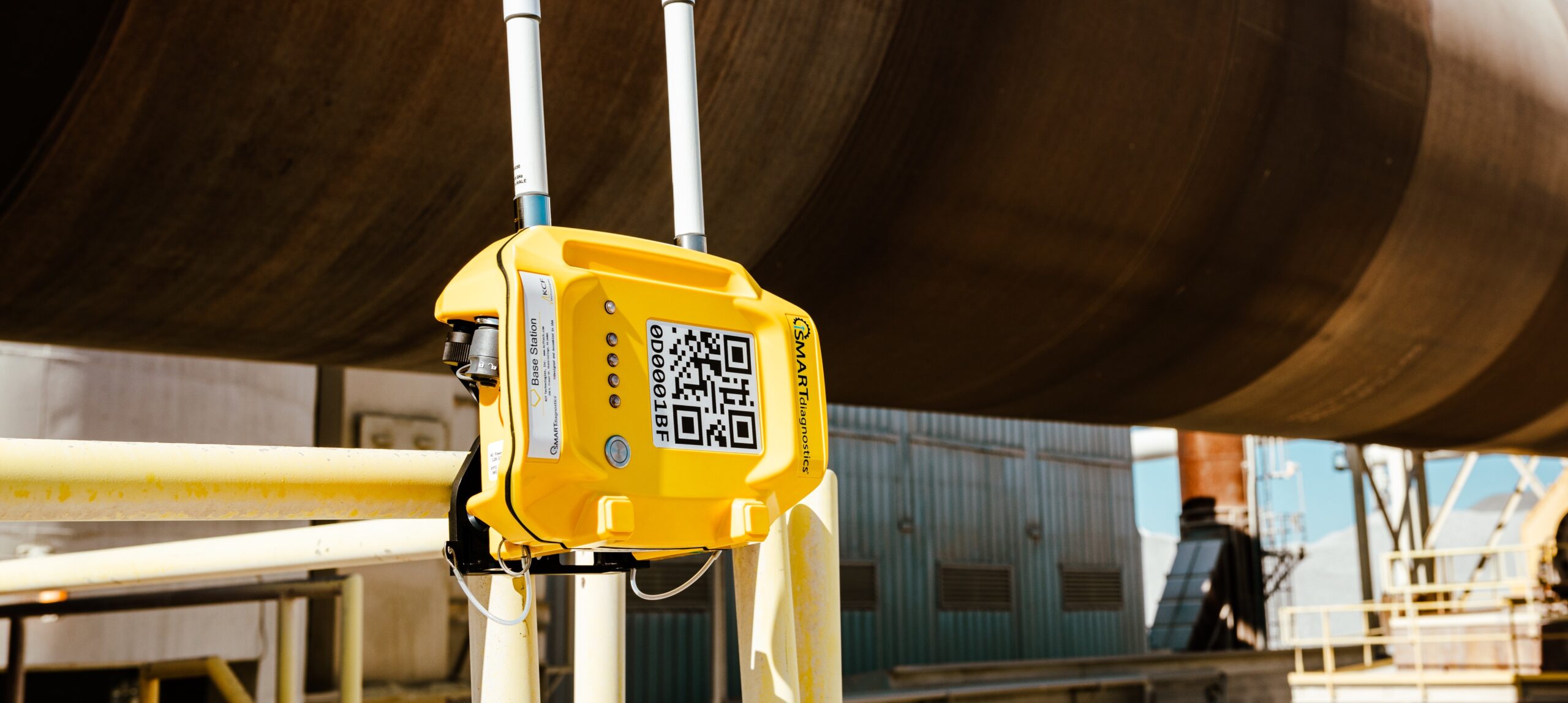
Installation is designed to be fast and non-disruptive, even in busy plant environments. KCF’s wireless high-definition vibration sensors can be deployed and start generating data within minutes, with no complex wiring or plant Wi-Fi setup required. Each sensor has a magnetic base, so it can be placed on a monitoring point without tools; where magnetic mounting isn’t suitable, sensors can also be epoxied or mounted with standard studs. Base Stations, which transmit machine health data to the cloud for processing in SMARTdiagnostics, mount with brackets, and sensors automatically pair with the nearest Base Station once installed. Most teams see actionable machine health insights within a day. On-site staff can typically complete installation themselves, and KCF also offers a hands-on install service where KCF’s team installs and optimizes the system directly.
In most cases, yes. KCF’s IoT HUB can ingest data from third-party, OEM-installed, legacy, or IEPE sensors, so existing sensor investments don’t need to be replaced. Once ingested, that data trends in real time in SMARTdiagnostics alongside KCF’s own sensor types. For questions about a specific sensor model, contact KCF directly.
SMARTdiagnostics detects a broad range of mechanical, electrical, and operationally driven fault types, and KCF continues to expand this list. As of February 2026, KCF Technologies can detect:
Yes. KCF offers sensing solutions that meet recognized hazardous location and industrial safety standards, though certifications vary by sensor model and application requirements. Full hazardous-location and IP ratings for each sensor are listed on KCF’s Hardware page.
Yes. KCF’s Piezo sensing solution was developed specifically for both ultra-low and high-speed assets. It records 96,000 samples per second to detect subtle bearing faults and can operate at speeds as low as 2 RPM, delivering handheld-capture-quality data continuously and remotely rather than as isolated, periodic readings.
Yes. KCF’s IoT HUB integrates with PLCs to trigger and collect data based on actual running conditions rather than collecting continuously. Connecting a PLC to SMARTdiagnostics lets a team correlate operating conditions with equipment health to adjust and optimize how equipment is run.
High-Definition Vibration Monitoring is KCF Technologies’ approach to vibration sensing, and it’s a different design choice than the High-Resolution sensing most predictive maintenance vendors market. High-Resolution sensing captures large amounts of data at less frequent intervals. High-Definition sensing captures medium-resolution data at more frequent, full-spectrum intervals.
The practical difference: High-Resolution data is like a single high-resolution photo of a football game, detailed enough to see a player’s gloves but unable to show which direction they’re moving or whether a play is in bounds. High-Definition data is like a sequence of photos that captures the dynamics of the field over time. It may not resolve a shoelace, but it doesn’t need to. The extra detail High-Resolution sensing captures often just adds noise, making it harder to pinpoint the root cause of equipment damage. High-Resolution sensing can help prevent a machine failure, but High-Definition sensing is what identifies the root cause needed to reduce the total number of maintenance incidents over time.
KCF’s High-Definition Vibration sensors are rated for up to 5 years of battery life, though most customers see an average of 3 years, depending on operating temperature, the customer-selected update interval, and signal availability. Battery changes use a standard, store-bought CR123A battery and require no tools: open the sensor’s top latch and insert a new battery in seconds. This no-tools, easily sourced design matters most at scale, where managing battery replacements across a large sensor deployment can otherwise become a significant maintenance burden.
Want to eliminate unplanned downtime and extend the lifespan of your critical assets?
Contact us to see how our comprehensive, AI-driven predictive maintenance platform can optimize your operations.