
KCF Technologies’ Machine Health Platform offers comprehensive solutions that cater to these complexities, particularly with its advanced Piezo Sensing module designed for low-speed, high-temperature environments, such as dryer cans .
Dryer cans, which comprise the longest and most critical section of the paper machine, are particularly difficult to monitor due to their slow operational speeds and high temperatures. With around 40 to 70 dryer cylinders in a typical machine, KCF’s Piezo Sensing Solution stands out as the premier choice for effectively monitoring these vital bearings. By leveraging advanced enveloping techniques and delivering handheld-analyzer quality data, this solution detects bearing anomalies months in advance in dryer cans, ensuring optimal performance and equipment longevity in the paper-making process.


Detecting early stage bearing wear can be challenging without the right technology. KCF Technologies’ Piezo Sensing utilizes advanced high-frequency enveloping to isolate and highlight subtle impacts, achieving superior bearing fault detection. With the capability to record 96,000 samples per second and monitor equipment as slow as 2 RPM, this solution excels in diagnosing issues that other methods may miss. In addition, its ruggedized build allows it to withstand temperatures as low as -4F and as high as 149F.
The enveloping technology also targets low-frequency faults, providing a significant advantage in equipment diagnostics. This approach facilitates early detection of bearing faults by pinpointing impact sources, making Piezo Sensing an essential tool for monitoring critical machinery, as demonstrated in a case study of rotating looseness in a dryer drum.
A traditional FFT (in blue) misses the spacing of the impacts seen in the waveform. With enveloped data, shown in yellow a clear train of harmonics at the frequency of the impacts can be seen. Note, these impacts are at only 0.6 Hz or 35RPM. Traditional sampling cannot reveal these impacts or resolve peaks at a such low frequencies, while enveloping can.


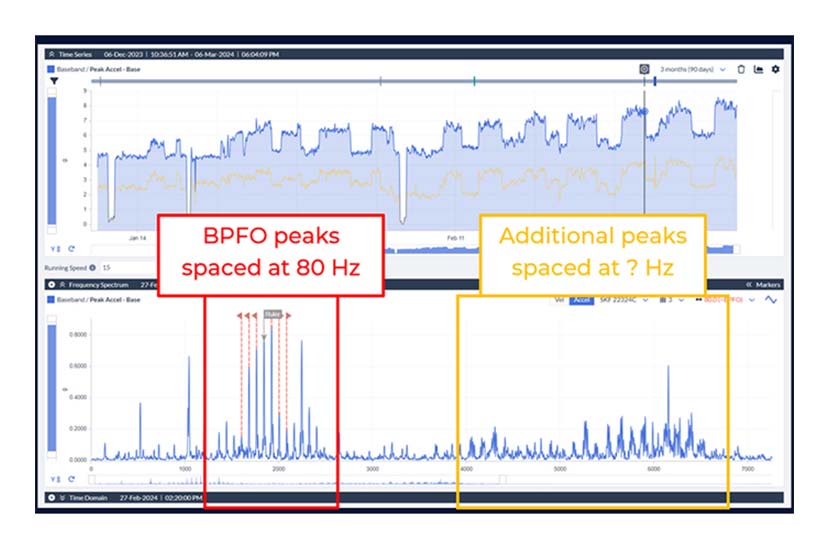
The image shows a concerning trend on a high-criticality bearing. There are obvious peaks in the raw FFT spaced at the BPFO (80 Hz). In addition, there appear to be peaks higher in the spectrum spaced at an unknown higher frequency.
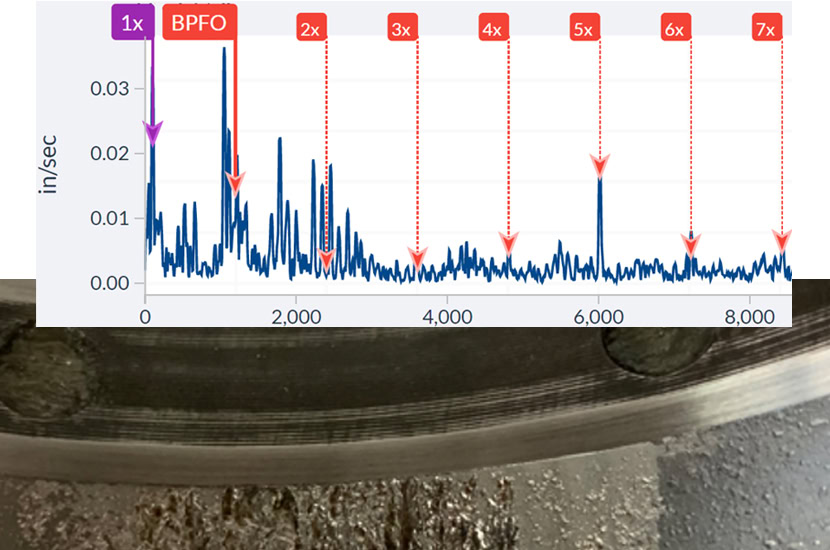
The FFT displays harmonics of the BPFI (123 Hz) with side bands of the run speed (15 Hz). Using enveloping, both BPFO and BPFI faults can be detected and tracked over time.


Dryer cans are pressurized steam vessels that make direct contact with fiber for drying purposes. When steam exchanges heat, it becomes condensate which then must be evacuated with a syphon.
Some common failure modes seen on dryer cans are:
Time Wave Form
Frequency Spectrum
Recommended Action
Root Cause

Frequency Spectrum
Recommended Action
Root Cause
Run speed
78RPM
Issue
Condensate can fail to evacuate from dryer cans resulting in less drying capacity and higher wear on the bearings
Monitoring Technique
Low pass filter with alarms for temperature and vibration.
Result
Early detection of a developing fault, which ensured work order could be executed quickly with minimal system instability and full drying capacity.


In another case study, the image below shows a concerning trend on a high-criticality bearing. There are obvious peaks in the raw FFT spaced at the BPFO (80 Hz). In addition, there appear to be peaks higher in the spectrum spaced at an unknown higher frequency.
When enveloped, the FFT displays harmonics of the BPFI (123 Hz) with side bands of the run speed (15 Hz). Using enveloping, both BPFO and BPFI faults can be detected and tracked over time.

The cause of the faults was found to be due to Electrical Discharge Machining from current leaking across the motor/gearbox coupling. Following this discovery, the customer installed an electrical discharge kit to isolate the two from each other, causing a drop in vibration back to healthy levels.