
If More Pixels Are Needed, the Core Issue Is Overlooked
Most vibration sensors collect infrequent, high-resolution data sets, typically once per day or every few hours, with frequencies up to 88 kHz, sometimes higher. This is analogous to capturing a very high-resolution photograph of a football game, where the image quality allows one to count the laces on the ball and identify the brand of gloves worn by the receiver. However, regardless of resolution, it remains nearly impossible to discern the player’s route, penalties, or whether the receiver landed in bounds. In contrast, a sequence of many images provides a comprehensive view of the play’s dynamics. This approach is known as high-definition monitoring, where the frequency of data collection is more critical than the resolution of individual images.
Many predictive maintenance companies emphasize high resolution because increasing resolution is relatively straightforward and serves as a competitive advantage. Off-the-shelf MEMS sensors from manufacturers such as ADI provide resolutions in the tens of kHz range, enabling sampling at these high frequencies. However, this approach reduces battery life and provides limited diagnostic value, except for specific slow-speed assets or equipment that require months of advance notice before faults develop.

In contrast, high-definition monitoring uses medium resolution but frequent full-spectrum readings. This is more difficult to do because the volume of data transferred is orders of magnitude higher than in common high-resolution monitoring. It requires specialized technology, much of which was developed for the US Navy and Army.
This form of high-definition monitoring, as opposed to high-resolution monitoring, is more effective for common equipment such as pumps, fans, motors, and gearboxes because it reveals operational behaviors that lead to failure. It detects rapidly progressing and intermittent behaviors that damage machines. Moreover, it identifies the underlying causes of failure rather than merely indicating how the machine is failing near the end of its life. To not only improve maintenance event management, which high-resolution monitoring facilitates, but also to reduce the total number of maintenance incidents, it is essential to understand the root causes of damaging events, achievable only through high-definition monitoring.
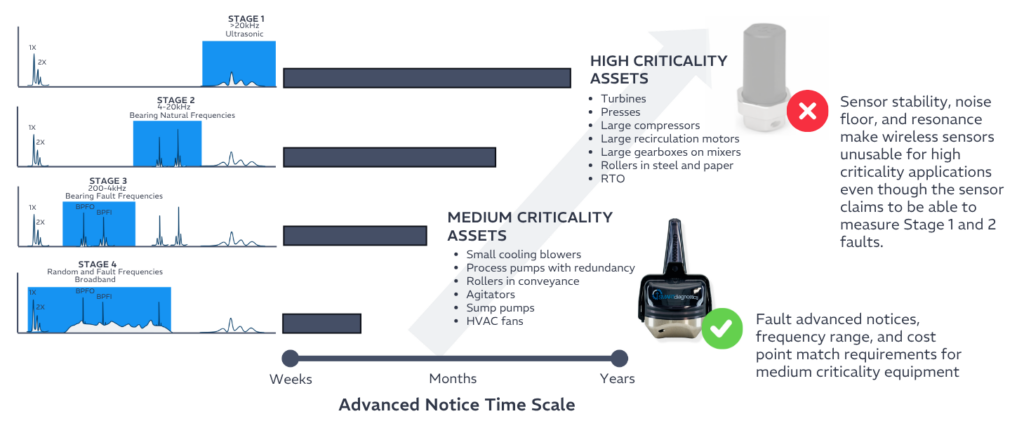
Equipment is damaged by various factors, including hard starts and stops, resonance, cavitation, over-greasing, excessive temperatures caused by debris buildup, moisture ingress, deadheading, aeration, grade changes, operation at critical speeds, pumps operating in parallel that are fighting each other, periods of high viscosity when cold, and excessive preventive maintenance, among others. Studies have shown that a typical pump in oil and gas facilities lasts only 20-50% of its rated life. This critical understanding and the value of high-definition monitoring are undervalued by some predictive maintenance companies because they cannot do it persistently, and it is not included in their monitoring programs. Instead, they emphasize very high resolution as the most important characteristic of a vibration monitoring solution. They often claim it enables early-stage fault detection, which is accurate. For example, in bearing cases, high-resolution monitoring can detect first- and second-stage faults, typically occurring three to six months before failure. However, experienced vibration analysts acknowledge that this early detection requires extensive scrutiny and fine-tuning of filters to ensure accuracy. Moreover, planning maintenance this early is only beneficial for certain high-value, long lead-time equipment.
The reality is that battery-powered vibration sensors are unsuitable for stage 1 bearing diagnosis on critical machines. A more reliable approach employs hardwired power and piezoelectric sensors for these assets. In fact, most balance-of-plant equipment in any facility exhibits minor stage 1 bearing faults. This very early detection is generally not useful for most equipment, as many bearings with minor damage or lubrication issues take several years or more to progress to stage 4 failure.