
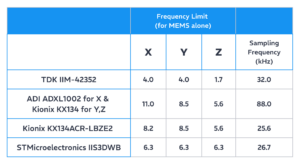
 The increasing competition among predictive maintenance companies to offer higher vibration sensor sampling frequencies, such as 25 kHz, 32 kHz, or even 88 kHz, is often based on the assumption that higher sampling rates are inherently superior. However, there is a significant distinction between simply recording at a high frequency and obtaining accurate high-frequency measurements. Much of the current discourse surrounding high-frequency measurement is not only misleading but also contributes to confusion regarding the factors that truly impact measurement quality.
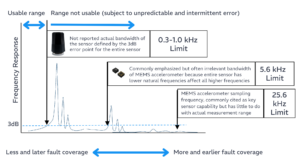 A critical but often overlooked consideration is the limitation on usable frequency range imposed by the sensor’s natural frequencies, which are distinct from the maximum sampling frequency. Both the vibration transducer (the core sensing element) and the complete wireless sensor assembly—including the battery and external housing—exhibit inherent resonance frequencies. At these frequencies, input excitation from the monitored machine can induce disproportionately large vibrations due to the sensor’s natural tendency to oscillate. This phenomenon is analogous to a swing responding most strongly when pushed at its natural frequency, resulting in amplified motion.
Due to the size, mass, and geometry of most predictive maintenance (PdM) sensors, even the most robust and well-engineered devices exhibit resonance frequencies that often fall within or near the measurement range for typical assets such as pumps, motors, and fans. Instead of prioritizing sampling frequency, it is essential to consider two primary factors: the first natural frequency of the MEMS accelerometer within the sensor and the first natural frequency of the entire sensor assembly. These frequencies define the sensor’s reliable operational frequency range.
For most MEMS accelerometers utilized in wireless sensor products, natural resonance frequencies typically fall within the 4–8 kHz range. The ADXL1002 is a notable exception, exhibiting a natural frequency of 21 kHz. In general, the first natural frequency of the entire sensor assembly can be significantly lower. One study reported that the first transverse natural frequency of a common wireless sensor ranged from 300 to 600 Hz, with peak measurement errors reaching 360%.
Before purchasing a vibration sensor, request information on the MEMS accelerometer’s natural resonance frequency and, if possible, obtain a frequency response plot for the entire sensor. Both pieces of information should be readily accessible. Additionally, inquire about the specific MEMS sensors used and verify this information against available reference data to ensure accuracy. If the predictive maintenance provider is unable to explain natural frequency or avoids the question, this may indicate a lack of understanding or an attempt to obscure a critical limitation. Conducting this evaluation can help prevent future issues and reduce the likelihood of false positive readings.