
Landfill gas collection does not tolerate improvisation. The blower skid pulls gas out of the cell continuously; when a blower goes down, collection is interrupted, and the interruption is visible to regulators, to the flare, and to anyone downstream depending on that gas.
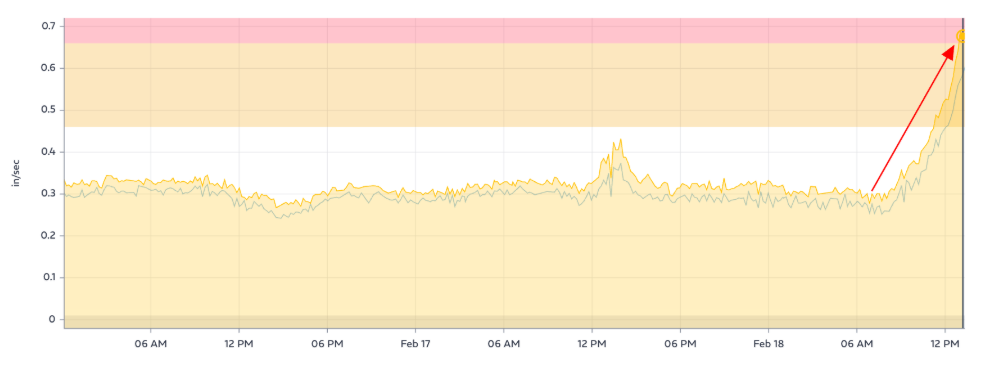
SMARTdiagnostics opened a Moderate issue on Blower #1 without anyone asking it to. Overall vibration at the motor inboard had roughly doubled in five hours, climbing off a flat 0.30 in/sec baseline to 0.67 in/sec, with a strong increase at 1X run speed and elevated bearing noise underneath it.
The KCF Technical Analyst classified the fault as Bearing Fault with Structural Looseness and gave the site two recommendations: confirm that all mounting bolts, welds, and shims were secure and in good health, and stage a replacement motor rather than running the asset to failure. The site planned the swap for its next scheduled outage.
The KCF Technical Analyst escalated the asset into KCF’s Motion Insights beta and asked KCF’s onsite representative to capture a motion amplification video during a site visit.
Motion amplification takes ordinary high-speed video and mathematically exaggerates sub-visible movement. Turning displacement measured in thousandths of an inch into motion a person can watch. At 20x amplification with the blower at 1200 RPM, the answer was immediate: the skid rail was rocking on its rubber isolation mounts. The pads were compressed and worn through, and the skid, which rests on those mounts and is not bolted to the concrete, was free to move with every rotation.
The video localized the issue in a single clip, in front of the people who would actually do the work.
KCF updated the recommendation: replace the rubber pads under the skid. The site’s maintenance team completed a few days later.
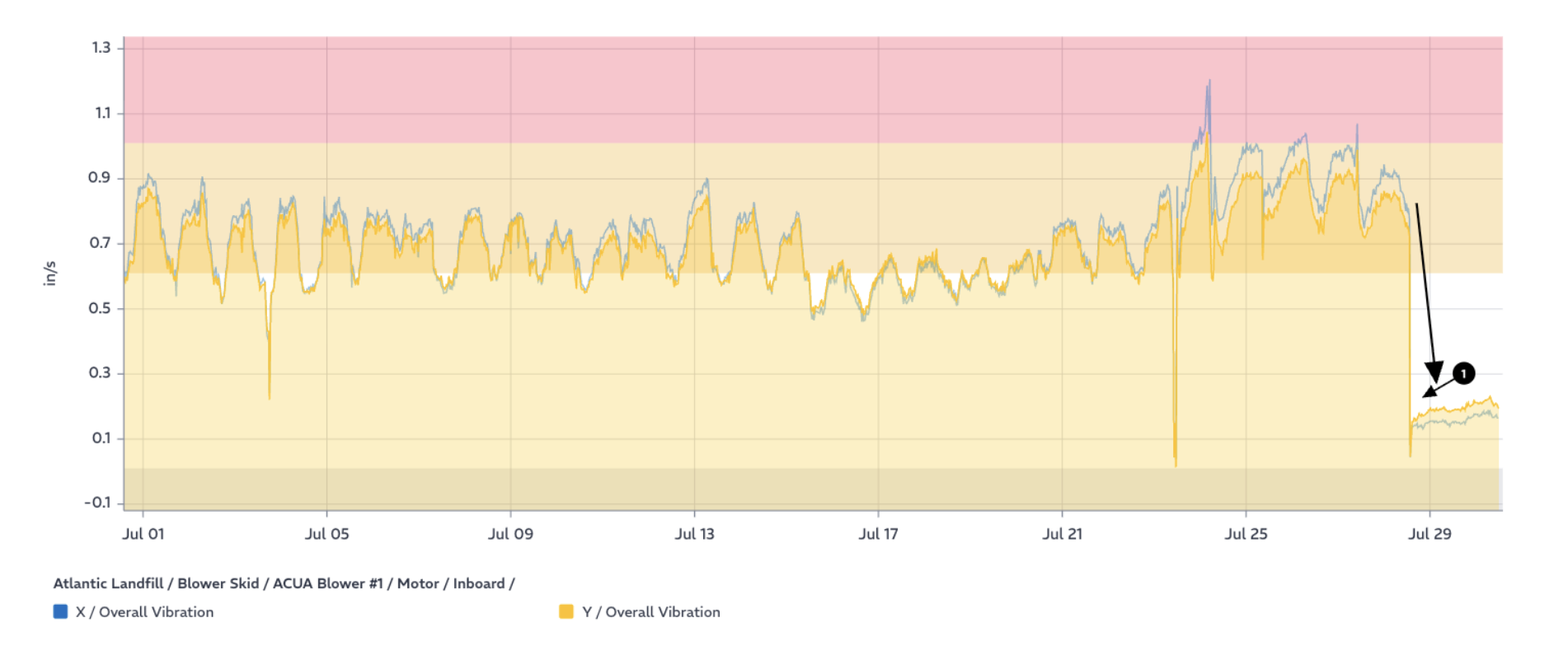
Vibration fell from a running range of roughly 0.7–0.9 in/s, with peaks above 1.2, to a steady 0.15–0.2 in/s — an approximate 80% reduction, and the lowest sustained level on record for the asset. KCF closed the issue with the final cause recorded as wear and tear on the skid mounts.


