
In a Municipal Utility District, the diligent monitoring of equipment led to the early detection of an impending failure in their 40 HP Aeration Blower, labeled as Blower 8. The blower began to show alarming signs when KCF Technologies SMARTdiagnostics software detected an unusually high overall vibration. This elevated vibration was particularly driven by a spike in its run speed, often a harbinger of severe machinery imbalance or even structural issues.

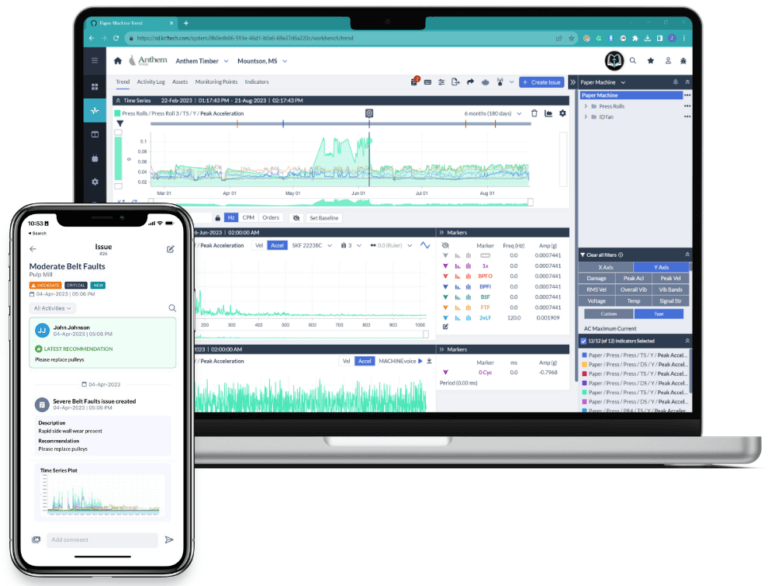
On the night of May 13th, at 10:48 PM CST, the monitoring system couldn’t ignore the anomaly anymore. An automated alert was dispatched, sounding the alarms about the potential issue. Two days later, on May 15th at 9:44 AM CST, KCF Technologies decided it was time to escalate the matter. They weren’t merely concerned about the persistent high vibrations; they feared the consequences of ignoring such signs.
Their concerns were validated upon inspection. Hidden within the depths of the Blower, a bearing, essential for smooth operations, was discovered to be cracked. It was a ticking time bomb. If not for the timely detection, the blower might have suffered severe collateral damage, leading to a potential shutdown and hefty repair costs.
Thankfully, the cracked bearing was swiftly replaced. The blower’s vibrations returned to their healthy baseline, and a potential catastrophe was averted. It was a testament to the importance of 24/7 monitoring and the swift actions that follow the detection of anomalies.
In another Municipal Utility District, an urgent alarm was brought to the attention of the maintenance team. Blower 2 of the 75 HP Aeration system, a critical component of the district’s infrastructure, was exhibiting troubling signs. The monitoring system, SMARTdiagnostics, developed by KCF Technologies, had picked up on these anomalies.

At a local Municipal Utility District, Blower 6 of the 40 HP Aeration system began showing troubling signs. As overseen by KCF Technologies SMARTdiagnostics Software, a spike in its usual humming was detected, indicating an anomaly in its smooth operations.

Two Significant Issues Came to Light: Problems with the coupling and potential misalignment. The former was evidenced by an overall increase in vibrations when compared to the blower’s typical baseline, prompting an automated warning to be dispatched. The latter, misalignment, was suggested by heightened 1x and 2x frequencies, particularly noticeable at the Motor IB and Blower IB monitoring points, known hotspots for such discrepancies.

In one Municipal Utility District, the Water Treatment Well Pump was under keen observation by KCF Technologies Machine Health Platform. Distinct anomalies were noted in the pump’s operations, even though a concrete fault type remained unconfirmed.

Diving deeper into the metrics, it was observed that the most significant impact of this irregularity was at the start of the operating cycle. The Pump Peak Acceleration Trend showcased these heightened peaks, mainly at the 1x run speed, which was especially pronounced at the cycle’s onset.
